 |
Ultra 0.9.4
|
Loading...
Searching...
No Matches
|
Ultra 0.9.4
|
#include <holdout_validation.h>
Classes | |
| struct | params |
Public Member Functions | |
| holdout_validation (src::problem &, params={}) | |
| evaluation_context | training_setup (unsigned) noexcept override |
| evaluation_context | shake (unsigned) noexcept override |
| bool | validation_setup (unsigned) noexcept override |
| std::unique_ptr< validation_strategy > | clone () const override |
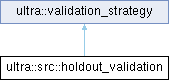
Holdout validation, aka one round cross-validation or conventional validation.
Holdout validation involves partitioning a sample of data into complementary subsets, performing the analysis on one subset (called the training set) and validating the analysis on the other subset (called the validation set).
|
explicit |
Sets up a hold-out validator.
| [in] | prob | current problem |
| [in] | par | parameters for controlling the splitting / subsampling |
Examples from prob.data(training) are randomly partitioned into training, validation and test set according to parameters contained in par.
User input Result (train / val / test) 0 / -1 70 / 30 / 0 0 / 10 70 / 10 / 20 80 / -1 80 / 20 / 0 80 / 50 80 / 20 / 0 100 / anything 100 / 0 / 0 -5 / 5 70 / 5 / 25
|
nodiscardoverridevirtual |
Creates a polymorphic copy of the validation strategy.
Implements ultra::validation_strategy.
|
inlinenodiscardoverridevirtualnoexcept |
Changes the training environment during evolution.
Implements ultra::validation_strategy.
|
nodiscardoverridevirtualnoexcept |
Prepares the data structures / environment needed for training.
Implements ultra::validation_strategy.
|
overridevirtualnoexcept |
Prepares the data structures / environment needed for validation
Implements ultra::validation_strategy.
 1.15.0