 |
Ultra 0.9.4
|
Loading...
Searching...
No Matches
|
Ultra 0.9.4
|
#include <search.h>
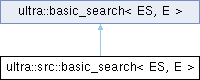
Public Types | |
| using | individual_t = typename ultra::basic_search<ES, E>::individual_t |
| using | fitness_t = typename ultra::basic_search<ES, E>::fitness_t |
| Public Types inherited from ultra::basic_search< ES, E > | |
| using | individual_t = evaluator_individual_t<E> |
| using | fitness_t = evaluator_fitness_t<E> |
| using | after_generation_callback_t |
| using | refinement_callback_t |
| using | on_training_new_best_callback_t |
Public Member Functions | |
| basic_search (problem &, metric_flags=metric_flags::accuracy) | |
| auto | predictor (const individual_t &) const |
| bool | is_valid () const override |
| Public Member Functions inherited from ultra::basic_search< ES, E > | |
| basic_search (problem &, E) | |
| search_stats< individual_t, fitness_t > | run (unsigned=1, const model_measurements< fitness_t > &={}) |
| basic_search & | after_generation (after_generation_callback_t) |
| basic_search & | logger (search_log &) noexcept |
| basic_search & | refinement (refinement_callback_t) |
| basic_search & | on_training_new_best (on_training_new_best_callback_t) |
| basic_search & | messages (bool) noexcept |
| basic_search & | tag (const std::string &) |
| basic_search & | stop_source (std::stop_source) |
| template<ValidationStrategy, class... Args> | |
| basic_search & | validation_strategy (Args &&...) |
| basic_search & | validation_strategy (const ultra::validation_strategy &) |
| template<ValidationStrategy V, class... Args> | |
| basic_search< ES, E > & | validation_strategy (Args &&...args) |
| template<ValidationStrategy V, class... Args> | |
| basic_search< ES, E > & | validation_strategy (Args &&...args) |
| template<template< class > class ES, Evaluator E> | |
| basic_search< ES, E > & | validation_strategy (const ultra::validation_strategy &vs) |
Protected Member Functions | |
| model_measurements< fitness_t > | calculate_metrics (const individual_t &) const override |
| void | tune_parameters () override |
| Protected Member Functions inherited from ultra::basic_search< ES, E > | |
| virtual void | after_evolution (unsigned, const std::vector< model_measurements< fitness_t > > &) |
Friends | |
| template<Individual> | |
| class | search |
Additional Inherited Members | |
| Protected Attributes inherited from ultra::basic_search< ES, E > | |
| evaluator_proxy< E > | eva_ |
| std::unique_ptr< ultra::validation_strategy > | vs_ {std::make_unique<as_is_validation>()} |
| problem & | prob_ |
| after_generation_callback_t | after_generation_callback_ {} |
| refinement_callback_t | refinement_callback_ {} |
| on_training_new_best_callback_t | on_training_new_best_callback_ {} |
Drives the search for solutions of symbolic regression / classification tasks.
|
explicit |
Builds a new search class, user chooses the evaluator.
| [in] | p | the problem we're working on. The lifetime of p must exceed the lifetime of this class |
| [in] | m | a bit field used to specify metrics we have to calculate while searching |
|
nodiscardoverrideprotectedvirtual |
Calculates various performance metrics.
| [in] | prg | best individual from the evolution run just finished |
Fitness and accuracy are calculated by default. Additional metrics must be explicitly requested in the basic_search constructor.
Reimplemented from ultra::basic_search< ES, E >.
|
nodiscardoverridevirtual |
Reimplemented from ultra::basic_search< ES, E >.
|
nodiscard |
Creates a predictor associated with a given individual.
| [in] | ind | individual used as building block for the predictor |
The returned object depends on the evaluator used during training:
This function is always well-formed: lack of predictor support is handled at compile time via the no_predictor fallback rather than via runtime errors.
|
overrideprotectedvirtual |
Tries to tune search parameters for the current problem.
Parameter tuning is a typical approach to algorithm design. Such tuning is done by experimenting with different values and selecting the ones that give the best results on the test problems at hand.
However, the number of possible parameters and their different values means that this is a very complex and time-consuming task; it is something we do not want users to worry about (power users can force many parameters, but our idea is "simple by default").
So if user sets an environment parameter he will force the search class to use it as is. Otherwise this function will try to guess a good starting point and changes its hint after every run. The code is a mix of black magic, experience, common logic and randomness but it seems reasonable.
Reimplemented from ultra::basic_search< ES, E >.
 1.15.0